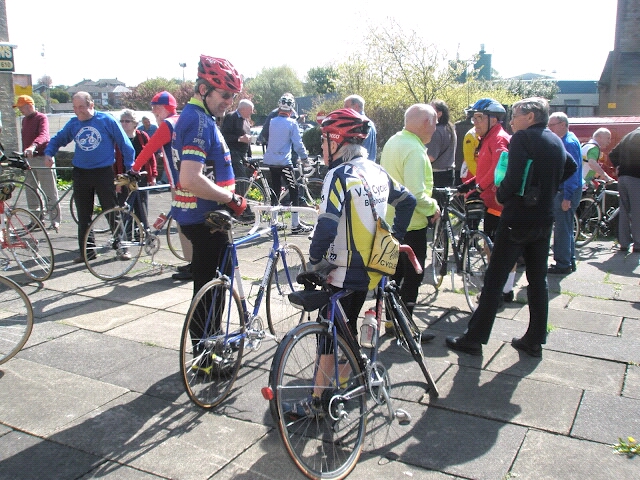
Bike Wash

  1. Fill bowl with warm water and washing up liquid
  2. Take outside with large and small sponges, kitchen towel, chain lube, GT85
  3. Wash bike with lots of soapy water and large sponge from top  to bottom including wheels and especially pedals
  4. Use small sponge/brush for tricky bits
  5. Empty dirty water down drain
  6. Fill bowl with clean water from tap
  7. Rinse bike thoroughly
  8. Repeat as necessary
  9. Dry/polish/rub bike and especially chain with kitchen towel (also removes greasy bits nicely with a rub)
  10. Apply cháin lube to chain following instructions on bottle
  11. Spray pedals and gear cable adjusters with GT85, wipe away excess with kitchen towel
  12. (Apply a very little lube to pivot points on derailleurs)

Wiggins the Olympian?

Early yesterday I made the mistake of visiting the clinic. It turned out that almost everyone there thought Bradley Wiggins was a doper, either due to his team’s association with Geert Leinders (ex-Rabobank team doctor) or his supposedly extra-terrestrial power output during Stage 7. It was fairly depressing reading, which was shunted back into the positive by some more rational discussion on twitter about the leaders’ power outputs: the best estimates (based on Brajkovic who lost a bit of time to Wiggins) suggested to @scienceofsport that the leaders’ performance did not imply blood manipulation. Thus I felt happier, given that I would rather not see yet another Tour de France winner popped for doping. We have had too many of those in recent years (doping is not ancient history, contrary to the impression given by some professional cyclists).

This brief happiness lasted until it became clear that Wiggins seems to think doping is a problem created by fans and media, rather than riders and their teams. We do share a joint responsibility for engaging constructively with doping, but some of the most intelligent discussion of such matters occurs on twitter, on blogs, and even in the clinic (alongside ridiculous speculation). It disappoints me that Wiggins seemed so oblivious of the opportunity he had to respond constructively as the tour leader. Athletes (Olympians especially) have a responsibility to adhere to the underyling values of their sport, and indeed promote the, in order that they set an example. Sport is not just a job for those who agree to be part of an Olympic team:

Olympism is a philosophy of life, exalting and combining in a balanced whole the qualities of body, will and mind. Blending sport with culture and education, Olympism seeks to create a way of life based on the joy of effort, the educational value of good example, social responsibility and respect for universal fundamental ethical principles.

IOC (2011)

Those universal fundamental ethical principles underpin anti-doping. Cheating is against the rules of Olympic sport because it goes against the core values of Olympism. The stakes here are high, if we are to believe that sport is anything more than entertainment, spectacle and commerce. Jim Parry would like to suggest that Olympic sport can have such added value, providing a role model for behaviour, particularly for the young:

I believe that providing multicultural education in and for modern democracies is a new and urgent task, and one that must be made to work if we are to secure a workable political heritage for future generations. In the present global political context, this means promoting international understanding and mutual respect; and a commitment to the peaceful resolution of conflict. In the case of Olympism, I think that the formal values underpinning the rule structures of sport, acceptance of which by all participants is a pre-condition of the continuing existence of sporting competition, support at the educational and cultural levels such political efforts. Children who are brought into sporting practices, and who are aware of international competitions such as the Olympic Games and the World Cup, are thereby becoming aware of the possibilities of international co-operation, mutual respect, and mutual valuing.

Parry (2003)

Wiggins is an Olympic athlete, and should act in a way coherent with those values. If he wants us to believe, then he should be prepared to respond to what he sees as unfair criticism by reiterating his acceptance of the rules that govern the sport and acting as if he takes these rules seriously, not by swearing at anonymous critics who could simply be ignored or reacted to with factual rebuttal (the approach taken by Marco Pinotti).

Why am I an anti-social cyclist?

Cycling is a social sport, yet like music, it attracts some fairly anti-social characters. I love people, but my borderline social anxiety (or misanthropy according to some) has made my cycling life rather lonely: I do like the monastic solitude of cycling on my own, but I wonder whether this is entirely healthy. Answers on a postcard, or do comment if you will…

USADA and anonymous witnesses

According to velonation Lance Armstrong’s legal team are apparently attempting to discover the names of witnesses to his and others’ alleged doping, facilitation of doping and conspiracy to cover up after the fact, a step which is being resisted for fear that the witnesses may be intimidated or subject to smear tactics:

A letter sent by Armstrong’s attorney Robert Luskin to USADA this week shows that the Texan and his legal team are pushing for information that they could use in defending against the USADA claims.

They are trying to compel USADA to reveal the names of the witnesses who gave details of what they said were doping actions carried out by Armstrong, Bruyneel and others. “We cannot protect Mr. Armstrong’s rights without knowing who is saying what and what events that allegedly occurred over the course of a decade and a half,” Luskin wrote in the letter. “Even at this preliminary stage, your reliance on secret witnesses making deliberately vague charges is unconscionable.”

“In this case anonymity of the witnesses at the Review Board stage is also important to shield them from the retaliation and attempted witness intimidation that cooperating witnesses have faced in other matters related to the USPS Conspiracy,” it wrote.

Earlier in the letter, it outlined what it said were examples of such behaviour which had been used in the past. It was listed as point six on the list of points that would be made by witnesses should things go to a hearing. This was said to be “the use of fear, intimidation and coercion to attempt to enforce a code of silence (or omerta) by team members and employees to prevent detection of the Conspiracy or the prosecution of co-conspirators for anti-doping rule violations.”

velonation , 2012

I have written three times on this blog about the need for those involved in the practice of doping to be supported in supplying evidence to the authorities. I do not normally recycle my material, but I do think that what I wrote last year is worth revisiting. First, I wrote here in March 2011 about the need to embrace those that are prepared to tell what they know about doping, and the obstacles that stand in their way, taking whistleblowing about academic misconduct as a model:

I hope that Michael Shermer (2010) is right that the balance can shift in favour of telling the truth about doping in cycling. But the cost for those that do is often unbearably high. We should worry that it is only those who can leave cycling behind (e.g., Kimmage) or have been abandoned by it (e.g., Landis) that are prepared to reveal all (see e.g., the nyvelocity transcript, 2011).

Maybe we should welcome those who tell the truth about cycling, whatever their motivation.

Second, I wrote this in May 2011 about Tyler Hamilton’s decision to come clean, both to the authorities and the press about his experiences of doping:

the tipping point from omerta to openness requires the engagement of law, not just sporting regulations, and it is clear that this may end badly for many, Papp included. In the long run though, cycling must engage with the fact that blood doping has fundamentally changed the sport, and needs to be eradicated for its physical and mental health. Some still doubt the honesty or motives of those who testify in front of juries about what they have seen or done in their work as professional sportspeople: what has become clear only recently through the Bonds perjury case is that juries will convict those who have lied in their testimony about doping (and do care about the image sporting heroes present to the world), and that alone may impact positively upon efforts to challenge institutionalised doping in sport.

Lastly, I wrote here in September 2011 about the tendency of some to scapegoat those who testify in anti-doping and criminal cases against those that take, supply or facilitate performance enhancing short cuts:

 The danger here is that if individuals who come forward are pilloried as ‘snitches’, and every time their evidence is used they are attacked for perceived character flaws, this serves as a disincentive to others. I suspect that what actually underpins the criticisms of those like Papp (or Kohl, Landis, Jaksche) is a tacit belief that doping is a personal failing, and they therefore treat those who are caught (especially if they try to help themselves) as scapegoats. What professional cycling and its followers needs to understand is that doping is an institutional problem, and that scapegoating individuals will never solve these institutional problems, especially if it removes the possibility that they can help address the issues at a more systemic level (e.g., exposing practices and supply chains).

I am relieved to say that USADA seem to be making some attempt to support and protect those that come forward to tell their stories. That does not mean the witnesses will not face sanctions in the future (both Joe Papp and Tom Zirbel were sanctioned but received some mitigation in similar circumstances), but it does mean they can have  chance to contribute to the efforts to dismantle the systems that support doping. And that is the defining and distinctive characteristic of the recent USADA letter: this is not about individual acts of doping, but about the ways in which individuals might conspire together to facilitate and cover-up these acts.

1994

I used to be in an Experimental Rock Band, and I guess that is how I met @accidentobizaro. She knew our bassist’s girlfriend through her housemate/landlord (that’s a long story in itself).

I knew she cycled.

She knew I played live in a transparent plastic cape (yes, that kind of Experimental).

That is where Chris Boardman comes in: I was taken out by a car driver on the Essex Road cycling back to my flat to watch the Tour de France  coverage, Boardman having won the prologue that year and the Tour being  in Britain for a few days (Sean Yates wore yellow that year too). When I finally spoke to her on the phone that day (from our bassist’s flat, where I was hiding and feeling sorry for myself) I was in a state of ill repair, having left a man-sized dent in a saloon car, and suffered bruising and minor cuts. I wasn’t a very confident guy back then, and I think the accident helped me to loosen up…

I remember that day and people’s kindness and love so well. I never really thanked the couple that looked after me and transported me home in their van with my bike, or the St John’s Ambulance guy who checked me over by the road side.

We are still together in 2012 but part of me is still in 1994, at the beginning of things. I cycled to our first date…

They shoot horses: performance enhancement, risk-taking and the rage to master

In the last few days both the cycling and mainstream press have reported on the usage of presently undetectable performance enhancing drugs in cycling (see e.g., this article in de Telegraaf; this article on velonews.com). José Been wrote an excellent post on her blog tourdejose.com about two of these products, and following news of the arrest of Alberto Bèltran in El País, updated this with news that he had been caught with both AICAR and TB-500, making the link back to the arrest of Wim Vansevenant on the eve of last year’s Tour de France. Here I consider the implications of turning to such ‘new’ drugs for cycling in particular and sport in general. Continue reading

Review: Kinesis Gran Fondo Scandium

I celebrated my new job at work with a new frame. The criteria were comfort, mudguard clearance and handling. I have previously ridden steel and alloy, and considered titanium and full carbon for this purchase, but eventually settled on the alloy/carbon Kinesis Racelight Gran Fondo. My decision was strongly influenced by reviews in the cycling press, and price: the titanium version was just over my budget. I built up the frame with a variety of used and new parts.

Pros
This is a frame that is almost invisible in use. I was fairly underwhelmed on my initial rides, but soon realised how little this bike needed input from me. This was particularly noticeable climbing.

The ride is fairly firm, but rough roads are accommodated pretty well. The frame feels light and stiff, but not too harsh. Although some say scandium alloys ride more like steel this feels like a comfortable alloy training bike, and the excellent fork and carbon stays probably contribute more to its feel than anything else.

Although the finish may not to be everyone’s taste, it is well executed and distinctive. Be warned, the frame should come with seatpost (nice Selcof) and headset (cheap integrated): mine came with neither, although this was rectified fairly swiftly (I used neither in the end).

Cons
The single eyelets on the rear dropouts make fitting rack and mudguards tricky. Clearance is fairly minimal: with mudguards 23c tires are as fat as I would go. The head tube is really too short for a frame if this kind, and even those with better backs than mine will end up with excessive spacers.

Conclusions
As a deluxe training bike this is wonderful. Time will tell whether 23c tires are enough for audax rides on our rubbish British roads.

Speed and distance: the Andy Wilkinson paradox

I did my first turbo session of 2012 today. To be more accurate, it might be my first session of indoor sensory deprivation torture since January 2011: I can’t say I took up cycling to ride indoors. I can’t go out on Tuesdays during the day as my youngest son is at home with me, but the opportunity is there for indoor training whilst he is having a nap. Given that I don’t race, the wisdom of turbo training is a paradoxical one. The received wisdom of long distance preparation is slowly building a base; gradually increasing the duration if rides to match the distances encountered in competition. As with marathon training, there is an upper limit: it is probably not a good idea to prepare for PBP by gradually increasing training distances to 1200 km: a diet of long day training rides and events of up to 600 km is the sort of regimen suggested by Doughty (or Burke and Pavelka). Continue reading

Cycle journalism and the social media: anonymity or pseudonymity?

I have enjoyed, and will continue to enjoy Lindsey’s writing, but on social media, I think Benson has it.

Joe Lindsey and Daniel Benson (via nyvelocity) both shared their views today on the relationship between print and online journalism, and between traditional journalism and blogging. I think the latter has the more balanced and constructive analysis. Benson even singles out for praise some examples of interesting non-mainstream internet sources, including @inrng and @cyclismas; Lindsey is pretty down on twitter and blogging, and even implies that we should be suspicious of @inrng purely based on his “anonymity” (@inrng chooses not to publish under his real name in order to separate it from his real work, both might be compromised otherwise: see his about page). I would encourage you to read both posts (and a sample from the excellent inrng.com) and see if you agree with my opinion. However, @inrng is not anonymous, he is pseudonymous, and this is a signal difference.

Continue reading