The paradox of internal blood testing

One of the more mysterious aspects of recent revelations about the prevalence of oxygen vector doping is the role of internal testing of blood values. One might ask how it is possible such testing failed to identify the level of blood manipulation that is now becoming clear from evidence provided to the Puerto trial. The decision by Armstrong not to enter into an official internal testing programme with Catlin during his comeback is often seen as a signal that his interaction with Catlin was just a public relations game. Of course, Catlin is well aware how internal testing programmes can be perverted into early warning systems that actually facilitate doping, and still possesses in his infamous fridge the evidence that would demonstrate how dirty US athletics had become at at a time of intense internal testing. Of course, there is no paradox here, individuals and teams use blood testing to ensure they do not get caught by the official testers. Rasmussen’s recent interview on NOS (here in English with Dutch subtitles) confirms yet another purpose for such internal controls: to manipulate and maintain internal hierarchies within a team. As we know from the Hamilton book, and from Voet’s book on Festina, access to doping products is often controlled in such a way as to create a hierarchy of performance enhancement, with a group of favoured riders entitled to dope. Of course riders can choose to dope without the support of a team, but this presents logistical problems, and may be seen to be a deviation from a script. This where the Rasmussen interview becomes interesting. He notes that CSC stopped him from racing because his haematocrit was too high, and implies that one reason he switched to Rabobank was to be permitted to manipulate his blood as he saw fit. Indeed his difficulties at Rabobank revolve around discussion of how the team management retained control of blood doping to (probably) ensure that performances did not become too suspicious. In this way, internal testing becomes the enemy of anti-doping, not its friend.

Edited 09032013 to clarify testing of blood values, not for specific substances.

Beyond the car crash: Armstrong testimony

Most of the people I follow on twitter, whether professional journalists, or unattached commentators, seem extremely keen to dismiss any attempts by Lance Armstrong to belatedly confess his doping infractions. This is despite reports that he is prepared to testify against officials that facilitated his cheating. This reminds me of the vitriol hurled against Joe Papp, whose testimony to USADA and federal agencies in the US resulted in a reduced ban and a non-custodial sentence.

Many focus on Armstrong’s desire to control the Media, and indeed the role a confession might play in mitigating his exposure to civil, criminal or sporting litigation. My view is that his motives for revealing some of the institutional factors in professional cycling’s darkest times are fairly irrelevant. There is little enough incentive for elite sportspeople to be honest about the factors leading to exceptional performance: it is not enough to expect them to be honest because it is the right thing to do. That is a naïve position and will not advance efforts to control doping.

I will not applaud Armstrong for testifying to USADA, but I welcome it nonetheless. If we are serious about combating doping in sport an understanding of institutional factors and how they interact with personal motivation is essential. The Armstrong/USPS case presents an opportunity, and without his testimony, will always remain incomplete and inconclusive.

Change Cycling Now: observations

In response to a call from @cyclingfansvox, a twitter account set up to develop and channel the views of cycling fans, I made some brief comments on twitter about the output of the recent Change Cycling Now meeting in London. The document in question is downloadable as a PDF at the bottom of this post.

Here I expand on these comments, and welcome some constructive discussion. The thoughts are a bit raw and immediate, but that seems to be the spirit of the times.

Zero tolerance

The charter strongly opposes a zero tolerance, punitive approach to doping, and advocates a truth and reconciliation approach. I have argued here that anti-doping is not served by punitive scapegoating of individual riders, and the proposals might fit with this position. However, no amount of truth-telling by past perpetrators will improve detection of doping infractions unless it improves detection, education or deterrence. I am surprised that the charter does not explicitly link a measured approach to sanctions with steps towards improved detection, although one might argue that outsourcing anti-doping might improve detection if one believes that the UCI actively or passively fails to meet its obligations in this regard.

I have also argued that although disproportionate penalties for doping, especially where they dissuade openness, should be avoided, that the threat of criminal prosecution for doping or trafficking acts as a necessary component in deterrence, and that a criminal law enforcement approach has proved much more successful in bringing doping to light than traditional sporting law. The charter does not touch on these issues.

Independent approach to anti-doping

The approach to improving anti-doping proposed is a separation of investigation and enforcement from governance and promotion. This seems eminently sensible, and is in line with many national anti-doping approaches. However, given such a separation, it is interesting to consider where educational approaches might sit, or more importantly how to develop a joined up strategy to control doping that takes into account structural issues of reward. Points systems, remuneration policies, volume of racing and other drivers for doping would not be controlled by such an external body and there is a danger of the two entities running at loggerheads. The separation of USADA from USOC and USA Cycling has brought many benefits, but also much divided and arguably negative conflict.

Representation

The charter will stand or fall not just on its content but on perceptions of how well it represents the views of many stakeholders. It was pleasing to see two familiar stakeholders from the parallel world of twitter, and a mix of commercial, scientific, academic and sporting interests represented. It was also good to see two ex-riders, with rather different experiences of doping involved. However, the lack of current rider representation, and the bias towards riders who have doped was really puzzling, and will provide a serious barrier to any positive ideas being accepted by a crucial group. In relation to spectators too, neither of @velocast or @festinagirl (despite the initial press release) purported to represent fans: I would argue that for any real representation to happen a properly constituted fan body would need to first be created.

Focus on doping

As mentioned above, one cannot really tackle doping simply through testing and enforcement. Similarly, a focus on doping as opposed to taking a holistic approach to a sport might be hugely counterproductive. Moreover, this focus seems to assume that anti-doping is the major ill that faces competitive cycling. Many would disagree with this, perhaps selecting gender inequality or the professional focus. I would contend that to build a better sport attention to the whole journey from junior to masters competitor needs attention, across the sexes, amateur and professional.

Interests

A charter like this needs a clear and transparent declaration of interests from its authors. Here are mine: I hold no racing license and gain no financial or other benefit from cycling. Other members of my family race on an amateur basis. If you wish to take issue with my anonymity, then do read this and this. One of the fan delegates posted a useful positioning statement (the open letter below), but it is all too easy to portray some of the delegates as having revenge, or some other selfish motive behind their actions. I cannot judge this as I was not there, and cannot read minds, but this will always be a tricky issue to address.

open-letter (Scott O’Raw)

Charter-of-the-Willing (Cycling Change Now)
Welcoming doping into the home?

Paul Fournel is one of my favourite writers. ‘Need for the bike’ ranks alongside ‘The Rider’ as a paradigm of attentive, illuminating observation: that its topic (like that of Krabbé’s masterpiece) is cycling, is a bonus.
I wrote previously that although I respected and understood Fournel’s essay on doping in ‘Need’ I did not share his conclusions. He has a longer and more embedded understanding of the European tradition of competitive cycling than I, and a healthy dislike of false oppositions and hypocrisy. However, I fear the acceptance of doping as normative, however rational this might be: maybe my Anglo-Saxon lust for fairness and ‘truth’ is too deep, however hard I try to be more philosophical on such matters.
In the most recent edition of Rouleur (Dec. 2012: 86-7), Fournel responds predictably to recent revelations about Armstrong, and their place in our developing understand of doping in sport. He calls for us to ‘welcome’ doping, noting that perhaps only this will enable us to rationally control and assess its impact.
I am not yet ready to welcome doping. However, I welcome Fournel’s critique of the often hypocritical approach to anti-doping we are in danger of adopting. We have a choice: either sign up to legalisation and control, or properly fund and support a huge and multi-faceted prohibition, with the attendant complexities: ethical, legal, psychological, medical and scientific.

My own Angliru: Cobo gearing

campagnolo centaur 12-30 cassetteWhen Campagnolo decided to market a 12-30 Centaur cassette it was so beyond the normal boundaries it barely fitted the box (designed for at maximum, a 13-29). I had such a torrid time in the last section of the Mills Hills sportive that I decided to down-gear to match some of the rather challenging hills close to my home in West Yorkshire. In particular, my nemesis: two sections of up to about 20%, and a final 10% section; about 8.5km of ascent, with two flattish sections to recover.

The winner of the Vuelta in 2011, Cobo, used a similar set-up to conquer the Angliru, famously beating Froome and Wiggins, the latter looking horrendously overgeared.  Large cassette, compact up front = not getting bogged down at the end of a long stage when the gradient gets insane.

My second attempt on this climb was after a rather less intense preamble.

I had ridden for less than two hours when I hit the bottom, and managed to ride the whole ascent, stopping to take some pictures after the second steep section. I was treated to some typical Pennine views, which I appreciated far better now I wasn’t wearing out my cleats.

Salmon in the Rain


Yesterday’s ride included some of the most torrential rain and hail I have seen. None of this crazy weather was predicted, and despite misgivings I chose to take my very best 80s ride, painted and built by Daniel Salmon. Crimped 653 tubes, Mavic, topped by a Flite: ‘trés nerveux’ and stiff for steel. It, and I, survived: but next time I think I will trust my eyes and wear my overshoes.
Salmon is still making bikes and, probably more famously, manufacturing alloy mudguards (fenders). Here are some really nice photographs (not taken by me) of his shop from 2003; much of his work is now in carbon, but there is some steel still in evidence. Check out this innovatively racked randonneur.

Haunting Malcolm Elliott

Kellogg's Tour of Brittain 1988. Winner Malcolm Elliott

Photographs are obvious catalysts for memory. They sometimes deliver more than one expects. Someone I follow on twitter posted some old pictures of the Kellogg’s 1988 Tour of Britain (which spookily include a blurred Jimmy Savile) today. I was there at the final criterium in Westminster,  and my hazy memories are formative in my passion for cycling (this was the first international racing I saw in the flesh). This photo of Malcolm Eliott,  who won that edition, is one I have seen before. However, I never noticed that I was in the crowd in the blurry background until today (unless I am seeing what I want to see)… and indeed Elliott was the first pro I had an on road encounter with (a few years later), in Sheffield, stopped at the lights.

Mills Hills Sportive: at last I enter an event (and finish too)

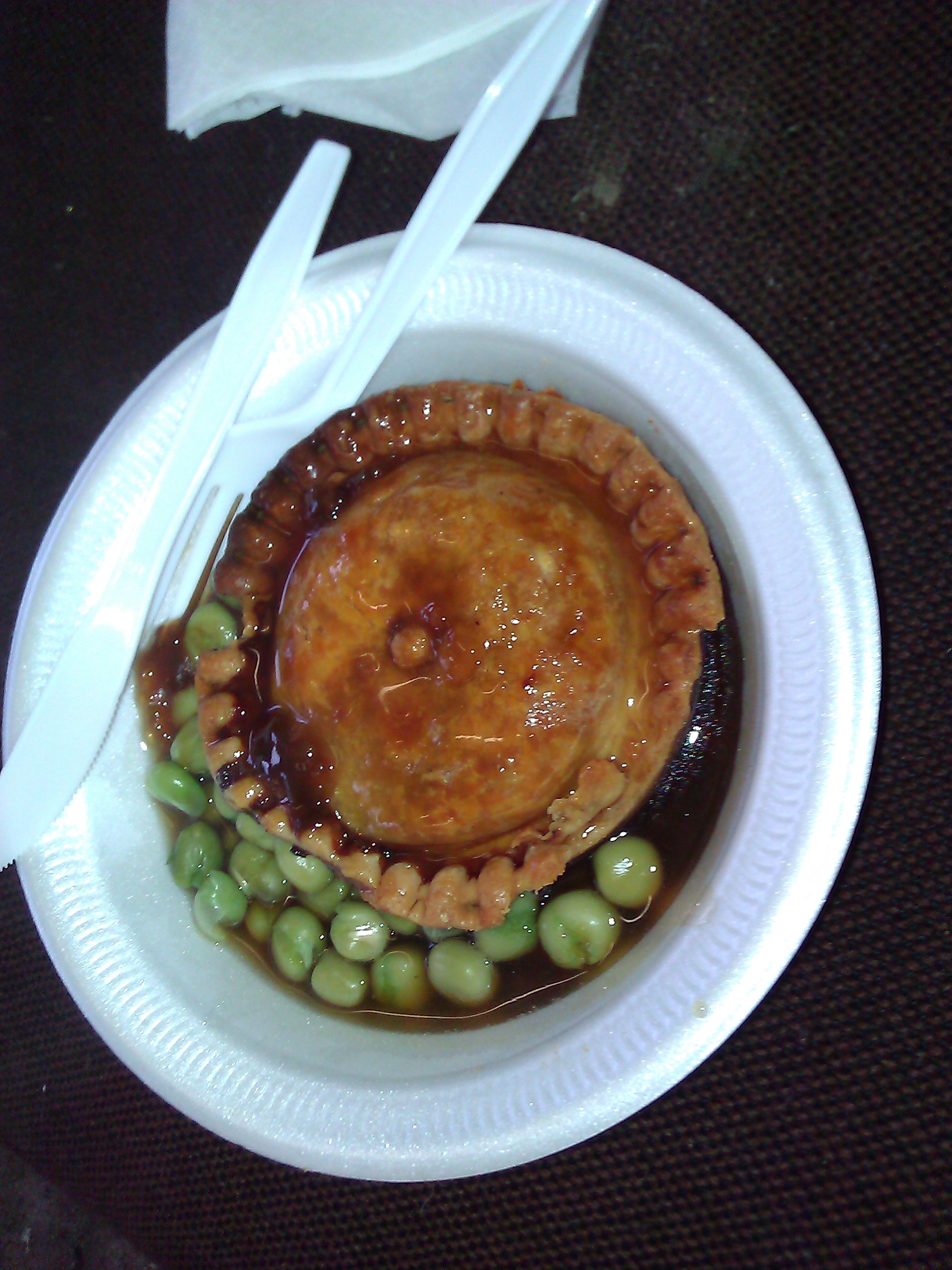
Pie and peas with gravyOver the last few years I have been failing to achieve even the modest riding objectives I aspire to. Despite the improved quality and quantity of my ‘training’ I haven’t completed a single organised ride; more accurately I haven’t started any. I entered two audaxes this year, and failed to start either, and this weekend was nearly the same old story of goals thwarted by circumstances or psychological self-sabotage. Instead I managed to enter, start and complete one of the toughest northern sportives (my first), overcoming pain and temptation along the route. Continue reading

Secret Race vs. Human Race: it’s all about Tyler Hamilton

I wrote the other day about why we should resist the tendency to focus on individuals in efforts to combat sporting fraud, especially doping. Instead, I argued, we should focus on the institutions and values that facilitate and encourage such behaviour. Paradoxically, it is individual cases and the personalities of individuals that can be pivotal in catalysing such a change in focus. That is why we should applaud the actions of those that lift the veil, rather than scapegoat and vilify. Here, I want to explore some of the personal qualities that emerge in one such whistleblower.

Tyler Hamilton’s recent book with Daniel Coyle (The Secret Race) might easily be portrayed as a book about doping in general, and particularly as a book about the behaviour and personality of Lance Armstrong and his confederates. Whilst this is a reasonable and accurate response, I think it would downplay a more positive and constructive narrative about an individual who seems peculiarly adept at battling physical pain, but much less equipped to deal with the psychological pain of life and competition. It is this peculiar combination that makes the book much more interesting than pure exposé. If we are to understand doping, I would argue, understanding the mindset of those who are prepared to publicly discuss it is an important step to undertake. Continue reading

Doping scandals: lessons learnt?

Ben Johnson, BALCO, Festina: sport often learns the wrong lessons from doping scandals. It learnt that coming clean about your doping when caught screws you and leaves others just as dirty to win; that if you have the right drugs and advice you will only get caught if someone gives you up; and that all sporting entities learn from a scandal is that a repetition must be avoided at all costs.
Continue reading